
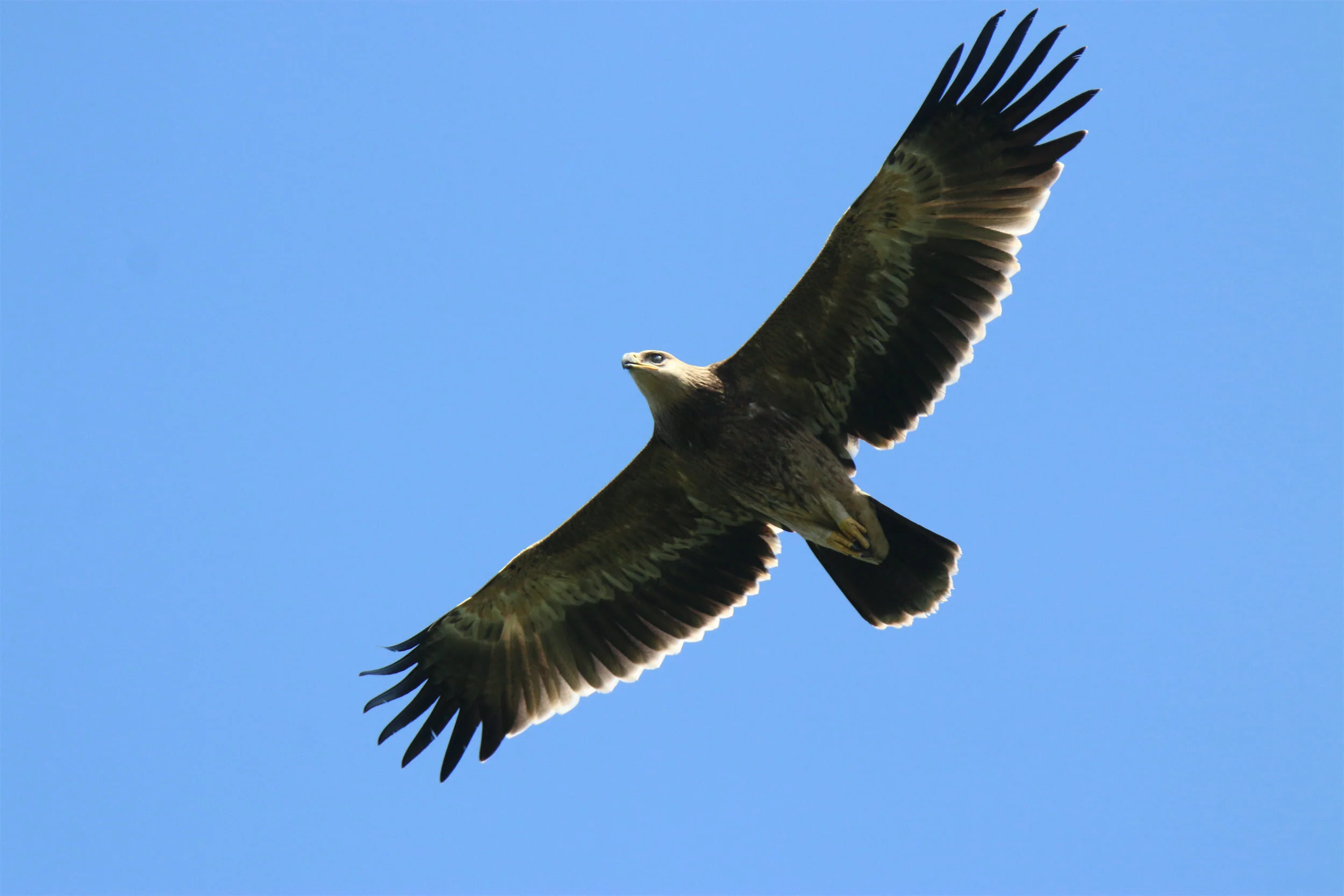
15-09-2015 Imperial overhead
I remember it was a rather slow migration day with quite a few tourists on station 1. One of the counters shouted out “Nobody move! Imperial eagle coming straight at us!”. An awkward silence followed while everyone was searching for the bird. Honestly, you couldn’t miss it… The silence transformed into a machine gun kind of sound from the camera’s taking pictures when the imperial eagle flew right above us. When it flew out of sight, people spontaneously started applauding, others became really emotional, one person even got very angry. The battery of his camera died just at that moment. Bird of the day for sure!
Photo by Wim Bovens.
Photo by Wim Bovens.
Photo by Wim Bovens.
10-09-2018 No time for a sandwich
Photo by Triin Kaasiku.
No time for a sandwich is a sign of a bloody good day.
In early mornings, the mountains in the east are cloudless, attracting birds to pass in small streams far inland against the rising sun. This is where you’ll pick up the first Marsh Harriers of the day by their distinct silhouette. Then it turns hectic. Hey, a juvenile Marsh overhead passing with two Montagu’s! Did you get this Marsh creeping through the valley, approaching the beginning of the ridge? Station 2, did you record two Marsh Harriers passing between the stations just now? Palm-top! A family group of Marsh in East 1. How many Marsh did you have in the stream of Honey Buzzard? Look, is this a dark morph bird?
You feel the adrenaline building up, you’re very awake, looking for more birds to tally. By the end of the day we reach 814 Marsh Harriers counted from Station 2 and 1130 both stations combined. Doesn’t sound much compared to the rivers of Honey Buzzard that we witness flowing by but finding the birds and looking carefully at each one of these sneaky migrants is both challenging and rewarding.
Photo by Triin Kaasiku.
07-09-2014 Batumi Roller Count
Photo by John Wright.
With the Rawhide theme song (Rollin’, Rollin’, Rollin’) as our background music on station, 2014 had some fantastic days with Roller migration. We had 9 days with more than 100 individuals and peak days of 428, 343 and 314 Rollers.
When we realized that it would be possible to break the BRC Roller record, we took things to a new level by introducing a mandatory dress code on station (blue of course!) to attract even more Rollers. It worked!! The Batumi Roller Count was born and we finally counted 2161 Rollers that autumn, which until this day is still the best ever year for BRC.
Photo by John Wright.
Photo by Hans Henrik Schou.
06-09-2018 Kites in the Wind
Photo by Folkert de Boer.
It was relatively quiet on the counting stations, so we went early morning on an excursion to the Poti Delta. When we left the hills of the lower Caucasus we noticed a lot of groups of black kites roosting along the road and small kettles of kites and honey buzzards gathering to proceed their journey to the south. This promised to be a good day of migration! And it became a memorable day for us, because we witnessed migration as we never had seen before.
When we almost reached Poti, we literally drove into a flock of black kites! After the usual skirmish in the bus to get out first, we were almost blown away; not only by having tens of black kites within arms reach, but mostly because of the severe wind.
This wind was of course also the reason for the black kites being so close. They really had to struggle to get to the south. We even saw black kites, heavily flapping, flying backwards. Whole groups were blown away as leaves in a storm. As annoying this had to be for the birds, for us it was truly an amazing experience.
Back at the office, it turned out that actually not many raptors did make it that day through the harsh winds over the high plains. In the couple of hours we spent on the road, we had seen a multitude of birds fighting the wind compared to the numbers counted.
Luckily the next day the wind had laid down, because that day over 60k raptors did arrive at our counting stations..
Photo by Folkert de Boer.
Photo by Folkert de Boer.
Photo by Folkert de Boer.
Photo by Folkert de Boer.
Photo by Folkert de Boer.

Extreme streams of Honey Buzzards
At the end of August, beginning of September, the Honey Buzzard is the main actor and the sound of clickers on fire is the soundtrack. Its migration peak in Batumi, although it depends on the weather, is not in a single day. There are several days in which an incredible stream of Honeys undulates meandering between the two stations. Testing the coordination and patient of both volunteers and coordinators at field. At dusk the stream stops and the HBs rest, they will continue the next day in the same place where they left off. For 3-5 days, and even longer, tens of thousands of Honey Buzzards a day pass through our heads, letting us see how incredible and spectacular the raptor migration is in Batumi.
Video by Bart Hoekstra.