Our first online identification presentation: Ringtail Harriers
Explore our new guide to Montagu's, Pallid and Hen Harriers, inspired by years of volunteer training at Batumi. Your photographs can help us improve it further.

We are adding something to the website that many of you have long been asking for: identification presentations! The first one is now online, and we have started with a group that gives even experienced counters plenty to think about: Ringtail Harriers — Montagu’s, Pallid and Hen Harriers. They are among the most difficult species groups to identify in the Western Palearctic, and a particularly familiar challenge in the Batumi Bottleneck.
The inspiration comes from the identification presentations we have been giving to our volunteers since the formative years of the Batumi Raptor Count. Until now, you generally had to join us in Batumi to see them. And while that is still the best way to experience them, we have finally put the time into turning that experience into something you can work through at home, at your own pace.
Before you dive in: please use a desktop or laptop to view the presentation. It is not yet optimised for mobile devices. There is a lot to look at in these photographs, and you will want the screen space!
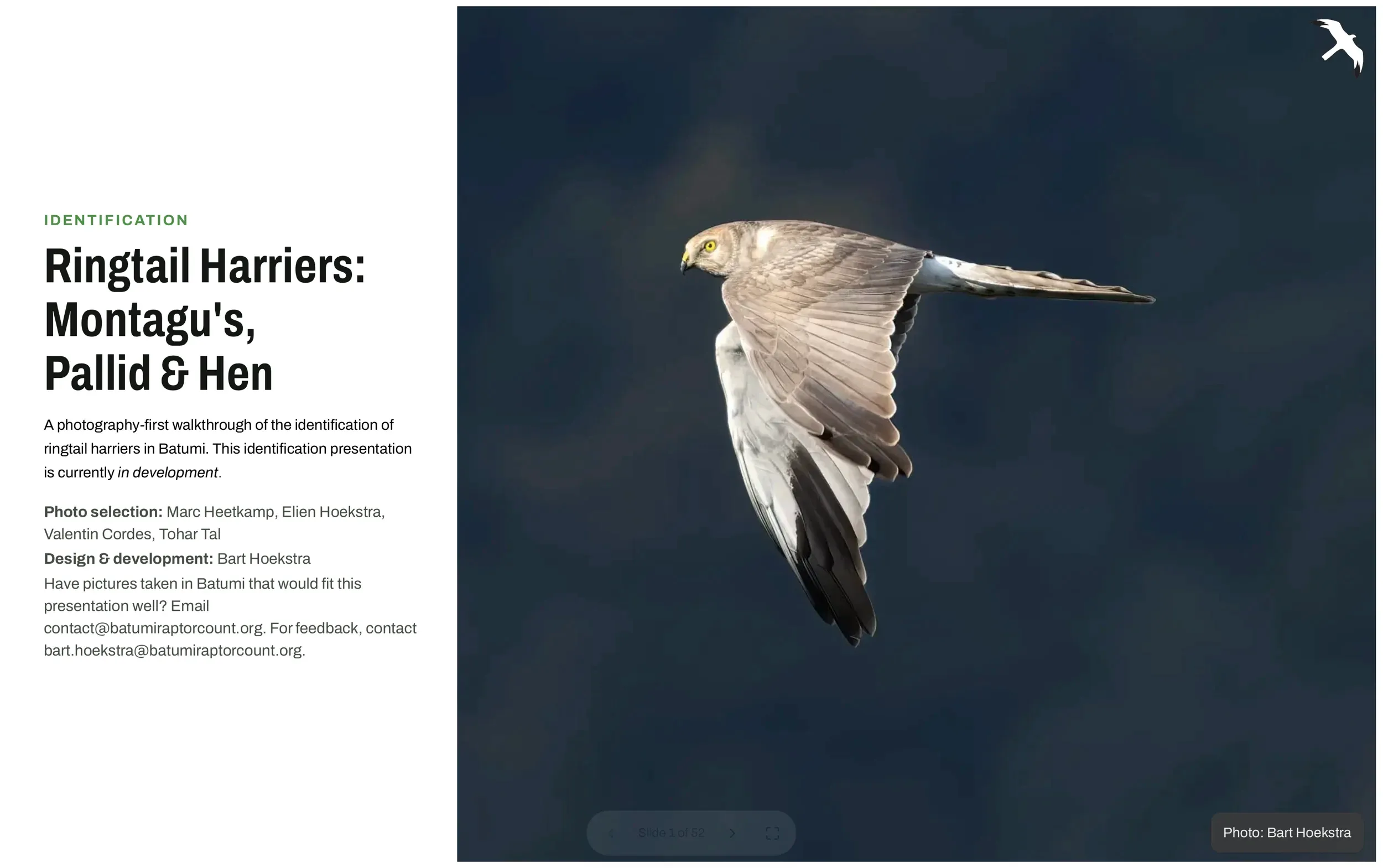 The opening slide of our Ringtail Harrier presentation, naturally with our logo species: a male Pallid Harrier.
Batumi birds & some room for improvement
This first version is still very much in beta. We will be making improvements to the presentation over the coming months, and we do not expect everything to be perfect from the start.
Part of the reason it has taken so long is that we want to show birds as they actually look when they cross the bottleneck. So we have tried to use only photographs taken in Batumi wherever possible. For some plumages or angles, however, finding a photograph that clearly shows several useful features at once is surprisingly difficult. A bird may show one character beautifully, while the angle or light hides another. In some cases, the pictures we have selected are not of great quality, but that reflects the challenge of photographing these birds in the conditions we encounter them in.
That is also where you can help. If you have suitable photographs from Batumi that are similar to those we have included in terms of angle and wing position, but sharper or higher in resolution, we would love to consider them for the presentation. Please send your photo contributions via WeTransfer to bart.hoekstra@batumiraptorcount.org. If you spot something that needs correcting, or have suggestions for making the presentation clearer, you can also send your feedback. Ideally, include a screenshot and let us know which browser you use.
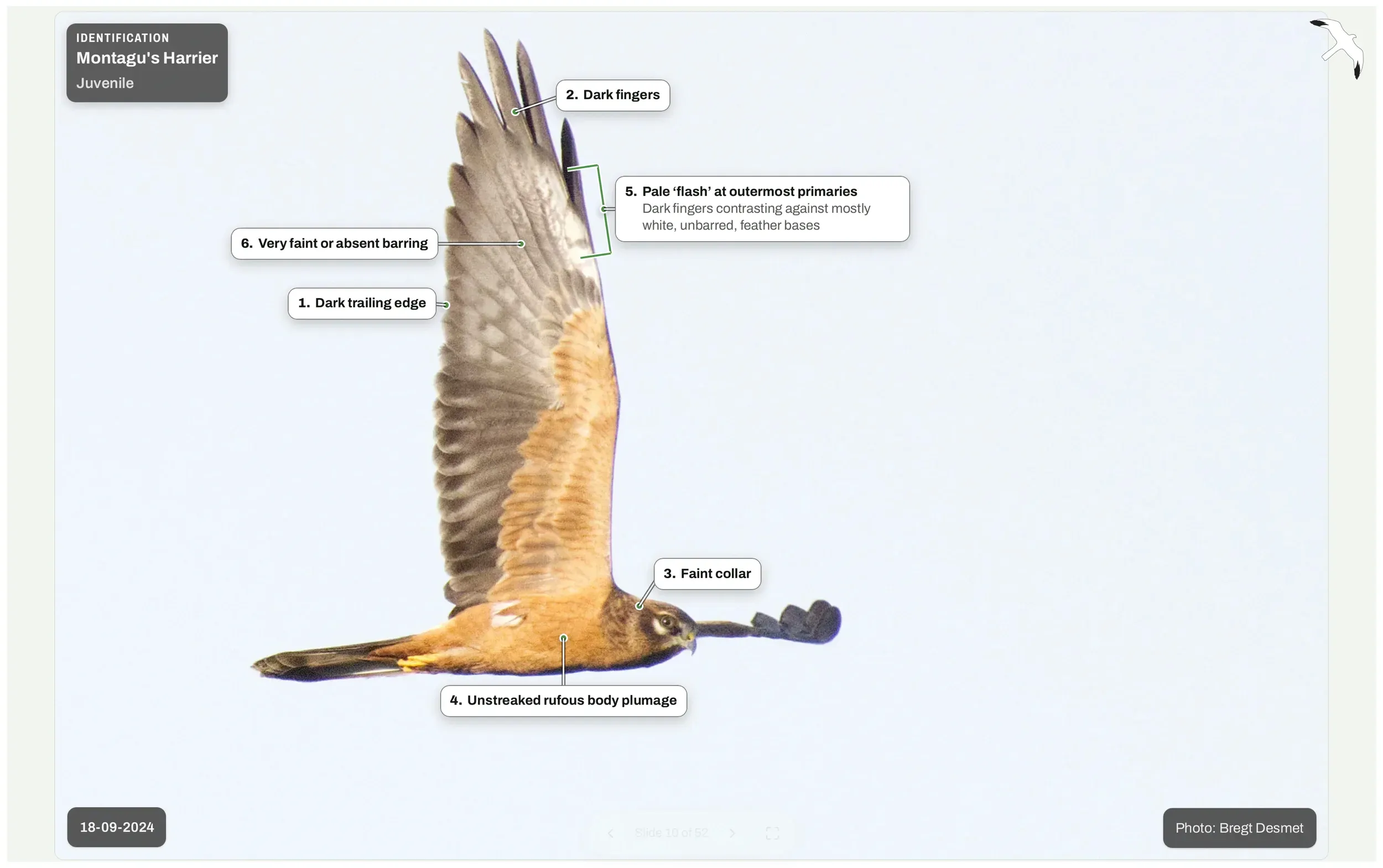 An example of how we use photographs to bring several identification features together on one bird.
More to share
Making as much of BRC’s work as possible openly accessible to the public is one of our long-term goals. Sharing our identification material is another step in that direction, although there is still a long way to go. Next, we are working on our other ‘key’ presentation, the one on Large Eagles: Lesser Spotted, Greater Spotted, Steppe and Imperial Eagles. We already welcome photographs for that one too, and are looking for pictures taken in the Batumi Bottleneck. Please send them via WeTransfer to the same address.
If you find the presentation useful, please consider making a donation to support BRC. As we explain in the presentation itself, the quicker we reach our fundraising goals, the more time we can spend on other work, including making these identification presentations. Your support helps us make room for the things we have wanted to share for years.
Enjoy working through the harriers, and let us know how you get on!